The International Labour Organisation's "World of Work Report 2012" projects that global unemployment will hit 212 million by the end of this year, up 6 million from 2011. Total unemployment in Ireland, the former "Celtic Tiger", is around 550,000 out of a population of six million. In Spain, 5.64 million (24.4%) are jobless. Some 50 million jobs have been lost since 2008, and unemployment is higher in two‑thirds of countries since 2010.

May 11, 2012
People's Voice Editorial: unemployment and resistance
Labels:
ilo,
unemployment,
young workers,
youth unemployment


The International Labour Organisation's "World of Work Report 2012" projects that global unemployment will hit 212 million by the end of this year, up 6 million from 2011. Total unemployment in Ireland, the former "Celtic Tiger", is around 550,000 out of a population of six million. In Spain, 5.64 million (24.4%) are jobless. Some 50 million jobs have been lost since 2008, and unemployment is higher in two‑thirds of countries since 2010.
May 10, 2012
Quebec solidaire calls for independent inquiry into police riot at Victoriaville
029482_high.jpg?size=sw380nws)
Victoriaville was the seen of a major confrontation and what some have called a police riot as the Quebec provincial police (SQ) used so-called "non-lethal" ammunition against a demonstration of labour, community and student protesters to ensure the security of a meeting of the Quebec Liberal Party.
The motion called for "an independent public inquiry of any link with police to shed light on the causes of serious injuries suffered by citizens at the event." At least three people were injured in the head and face by hard plastic balls. This type of ammunition is responsible for several deaths across the world.
Quebec students are making history
Labels:
quebec,
quebec solidaire,
quebec student strike 2012,
students,
YCL
As Quebec`s historic student struggle enters its 13th week of strike and constant mobilization, the battle has entered a new round. At the beginning of May the provincial Charest Liberals finally sat down with students and other groups to produce an offer that is now being voted on by students at colleges and universities across Quebec.
But already 18 out of 19 student assemblies have rejected the agreement by significant majorities, suggesting the conflict may be long from over. The Minister of Finance has suggested that ultimately, it may be the voters who resolve this crisis.
Student demonstrations have not slowed down either. For two weeks now, the students have been marching late into the night from 9 pm to 2 am. Hundreds of demonstrators snake through downtown Montreal, tailed and often blocked by muscular units of riot police who seem eager to gas the protestors or even beat them up.
Details: What is the offer that is being rejected by the Quebec students?
Labels:
quebec,
quebec student strike 2012,
students
 |
| April 25 night march in Montreal. Photo by The Dominion |
After a 22-hour bargaining session involving ministers of the Charest government, university and college heads, and leaders of the major trade-union centrals, the student leaders agreed on May 6 to put the offer to a vote of their respective membership without recommending acceptance. If the offer were accepted:
- The 75 per cent hike in tuition fees (now spread over seven years, but indexed) would remain, albeit with slightly liberalized access to scholarships and loans, and provision for repayment of loans geared to future income.
- A provisional committee would examine university budgets and propose possible cuts. Each dollar cut would go to reducing incidental fees not related directly to tuition (admission, registration, sports services, technology, etc.).
- The committee would include four students, but also fourteen other members: 6 university rectors, 4 trade union representatives as well as 2 representatives of business, 1 from the ministry of education, and a chair with a tie-breaking vote – the latter four all designated by the minister of education.
- The committee would table its recommendations by December although if necessary its mandate could be extended by one more year. It might then be replaced by a permanent committee appointed by law, its composition undetermined at this point.
- Pending the provisional committee's conclusions, the students’ incidental fees would be deferred. However, these fees would apply retroactively to the students in any amount the committee is unable to cut from current expenses.
There is no assurance that the proposed committee would agree on budget cuts sufficient to reduce or eliminate the hike in tuition fees. Furthermore, the committee would be composed largely of members with a vested interest in opposing cuts in expenditures, especially in research and funding of pro-business courses.
Summary by Richard Fidler.
May 8, 2012
F-35 Dangers Far Beyond Costs and Corruption, as Fighter Jet Program Also Used For Nuclear Weapons Development
Labels:
canadian peace congress,
f-35 figher jets,
militarism,
military,
peace,
solidarity,
war

Opposition to the Harper government's proposal to purchase 65 F-35 fighter jets has been consistent and growing. Most of it is focused on the related issues of costs and corruption that are associated with the procurement. This is critically important – military spending should always be conducted in an open and transparent manner, and it must be justified in the context of broader public spending. In an era of high unemployment, deep cuts to social programs and harsh austerity programs that target working people, Harper's intention of spending billions of dollars on fighter jets is thoroughly offensive, and it needs to be confronted and opposed by the largest possible mobilization of people.
The F-35 program is driven by the United States military and its NATO allies. In 1997, Canada signed onto the Joint Strike Fighter program, which was developed as a vehicle for the United States to capture international funding for a replacement jet fighter. Canada's initial investment in 1997 was $10 million. In 2001 the JSF contract was awarded to Lockheed Martin, who developed what is now known as the F-35. By 2010, the international procurement process was underway and Stephen Harper announced that Canada would purchase 65 fighter jets, through an untendered purchase.
May 7, 2012
Communist Party of Greece on Greek elections
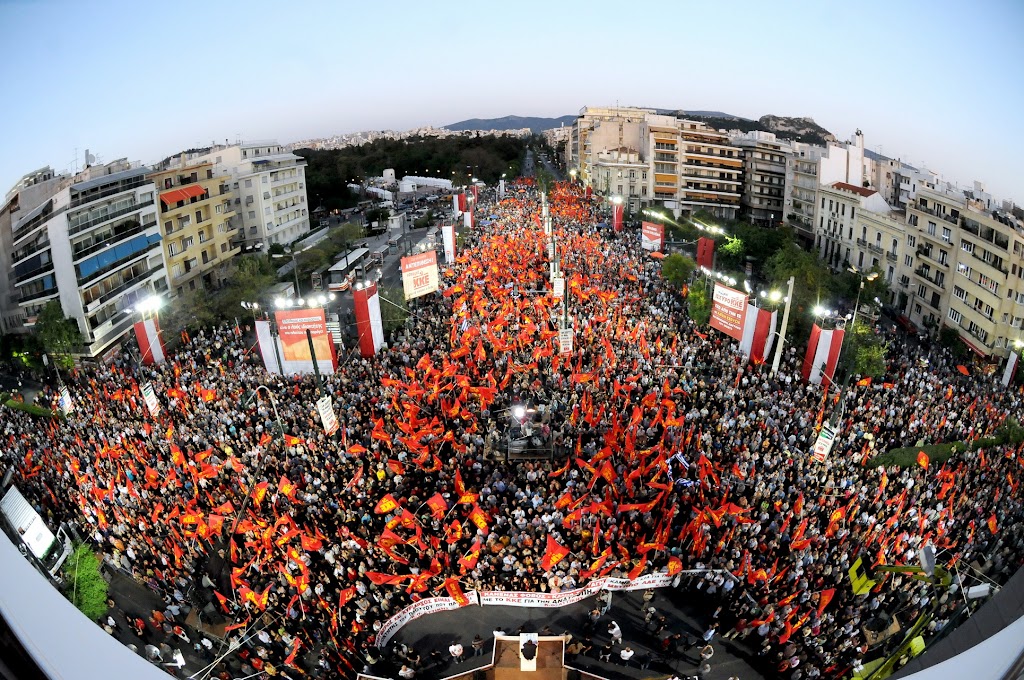
KKE: In the frontline of the struggles from today
against the new anti-worker storm
We address the members of the party, the members of KNE, the friends, the supporters, the voters, the people who cooperate with the party, to everyone who has been with us at the frontline of the movement and the electoral battle and call on you to be at the frontline of the struggles in the next days because we have pressing, serious issues which are in progress, such as the collective bargaining agreements, the protection of the unemployed, the bankruptcy of the social security funds, the new measures which amount to 11,5-14,5 billion euros which will be paid for out of the pockets of the people. We cannot waste any time. The people must not waste time.
Subscribe to:
Posts (Atom)
Popular stories
-
 Rebel Youth is looking for hitchhiking stories, and also experiences with the challenges faced by women, trans people, hitchhickers facing ...
 -
 The real abuse taking place in Cuba is the crippling and inhumane American blockade Rob Miller The Guardian, Thursday 26 November 2009 Your ...
 -
 Special to RY Tyson Strandlund is the Communist Party of BC’s candidate in the upcoming election in Esquimalt-Metchosin, British Columbi...
 -
A very important meeting for labour and social movements is taking place from August 21-24th in Ottawa. The People’s Social Forum (PS...
-
J. Boyden Yesterday, January 18 th , was the 24 th anniversary of the death of Renato Guttuso. Renato Guttuso (1911-1987) was a com...
-
 Jay Watts In 1995, a report issued as part of the Royal Commission on Aboriginal Peoples called suicide “one of the most urgent problems ...
 -
 World Federation of Democratic Youth (WFDY) would like to express its deepest condolences and sympathy to all those affected by the mu...
 -
 Adrien Welsh On April 23rd, the French people were called to chose two out of the eleven candidates running for the Presidential e...
 -
 This article is part of an seven-part series of short quotes Rebel Youth is issuing about class struggle, revolution, civil-war, and par...
 -
 Ajit Singh A couple weeks ago, a Palestinian child was beheaded by the "moderate rebels" in Syria, created, funded, and backe...

