September 29, 2012

Student organizing in the 1930s and the YCL

The On To Ottawa Trek
In the 1920s, 30s and 40s the Communist movement was under intense surveillance by the political police or Royal Canadian Mounted Police -- we know this because they have made their official secret documents public for this time period. The surveys continued, of course, after the 1940s and actually intensified but the reports from the years before show that the RCMP was already paying very close attention.

Below we present an RCMP report from November 1936, which includes a report about the work of the Young Communist League on campuses and a student conference organized by the YCL at McGill University. No doubt, not everything in this report is true. The informants used by the RCMP often exaggerated the statements of the Communists (saying, for example, that the Communists called for violent and bloody revolution in a public speech) to simply justify their existence as informers and spies. This organizational culture was supported at all levels of the RCMP who always monitored the CPC more closely than the ultra-right groups -- even when Canada was at war with fascist Germany and about to enter into an alliance with the USSR. As historian Chris Frazer writes in the latest issue of The Spark journal:
As chief of the RCMP's intelligence section, Rivett-Carnac argued in early 1939 that fascism was a lesser threat than communism since fascism was a "modified form of capitalism." Rivett-Carnac's opinion corresponded with the anti-communist and anti-labour views of RCMP Commissioner S.T. Wood, who argued later in 1941 that, "it is not the Nazi nor the Fascist but the radical who constitutes our most troublesome problem."[19] Although the charges were never substantiated, as early as October 1939 the RCMP Security Bulletin claimed that "there is more reason to fear ... acts of espionage and sabotage on the part of the Communist Party than from Nazi or Fascist organizations." Source.
The November 1936 report is from a series of security reports that the RCMP issued on a monthly basis. Much of what the YCL is interested in doing, as presented by this report, is anti-fascist work -- or campaigning for peace. At points the language of the document reads as if the informer simply copied the original text in shortened form. The sentence structure and wording is dated and has a kind of 1930s feel, but the thinking of young people at that time shines through.

The report states that student participants came from Queens (Kingston, Ontario) Dalhousie (Halifax, Nova Scotia), McGill (Montreal, Quebec) and Varisty -- which perhaps refers to the University of Toronto, whose student newspaper and sports teams are called that and where the YCL had an established public club at that time (although the word varsity simply means a university sports team or a university).  Two delegations also came from high schools in Montreal.

The conference called on YCLers to continue political and ideological work against "Capitalist ideology and propoganda in schools" but to combine this with immediate struggles and political work like peace, unemployment, youth rights, and united front work with other youth organizations. A strong parallel can be drawn with the work of the League today.

The report calls for "proper combination of broad campaigns on specific issues [...] with careful fostering of permanent student organizations." This approach may have some thing to teach youth and student activists today, with the spirit of Occupy, the "Casserole" solidarity protests, and other spontaneous actions on our campuses and communities. More often than not, these movements unfortunately fail to develop into real organizations and the youth movement swings along, after a few weeks or months, to the next popular issue.

Particular attention was given to the Canadian Youth Congress (CYC). The CYC included progressive religious youth through the Student Christian Movement which was the main social-justice organization on campuses at that time, but also farm youth, the Canadian Cooperative Federation Youth or CCF (forerunner of the NDP), as well as social and sports groups like the YMCA and YWCA (Young Men's and Young Women's Christian Associations). The CYC advocated for a Charter of Rights of the Youth or "Youth Act". It had just held, the year before, a series of protest actions against government policy during the depression -- like peoples courts against Prime Minister R.B. Bennett.

Despite that fact that most university students were not from the working class, interestingly the YCL report does not dismiss political action on campuses. Instead the League states that students are a diverse social group, generally inexperienced, and that schools varied considerably -- depending even on the personality of the school principle (or university President). As a result "no stereotyped formula can be given" but there was a sharp problem of leadership because of inexperience on campuses.

Further discussion

A lot of material is presented here which could be fruitful for further discussion about strategy and tactics.  At this time the YCL itself had only just fought and defeated, with the Communist Party of Canada, an effective ban on the organization. It was still on a precarious edge of legality.  Why would the YCL not want the Student Peace Movement to be an underground organization and forbid that direction?

Why would the YCL want official support of efforts like the CYC and peace clubs but not progressive clubs which are to remain independent?

What do you think about the experience and tactics of the YCL on high school campuses at Baron Byng and Strathcona?

Why do you think they thought it was necessary to write that"the club must neither be a collection of intellectual giants nor ostensibly be interested in nothing but ping pong while in reality acting as a snare for unsuspecting innocents"? What does this mean?

How are "linkages with the labour movement" maintained with YCL clubs in a way that is not "mechanistic"? What do you think about the example at McGill?

What do you think about the proposal for a YCL club meeting agenda on campuses and the idea of "all-talk-no-action"?

Although the story-teller is a police agent, the actual minutes from this meeting no doubt have been long lost. It is, therefore, an invaluable source of information. What we get is not the conference discussion in full, or even the complete final resolution. It is sifted by a police filter from the informant to the official report given here. The reader simply has to trust that most of the document is, more or less, accurate.

At the same time the report tells an important tale not just about the YCL but also the youth movement of the time. The final resolutions of the conference, for better or worse, show the thought-out contribution of the YCL to the students struggle: it identifies key priorities like peace and youth rights; it strives to find the maximum level of unity and militancy in the context; it navigates difficult questions like legality, illegality, and the public presence of the YCL; and it interconnects the youth struggle with other struggles.

The report especially tells its members to strive to work in a way that is not mechanistic or formulaic, to listen to its high school members, and to work in a collective fashion with initiative. Clearly, the League does not dismiss the campuses or reject participation in the political life of students -- even though access to education was much more difficult in 1936 than today for working class youth. And to be sure, campus activities were a relatively lower priority of the League which focused more on young workers. But in tacking the problems of the student movement of the day, the YCL shows its broad sweep of understanding struggle -- a revolutionary perspective of mobilizing the all the oppressed masses of youth in unity with the working class. Clearly the police though this vanguard approach towards the youth struggle in Canada was a real danger.


YCL at McGill

September 28, 2012

News on the youth movement in Cuba


The Cuban Federation of University Students ( FEU) will receive on its ranks this year about 30 thousand entrants to the Cuban universities.

The new FEU members will receive their cards in the entrance ceremonies to be held in each of the higher education institutions of the country, reports the daily Juventud Rebelde.

The Rafael Maria de Mendive University of Pedagogical Sciences in Pinar del Rio will be the venue of the national entry ceremony on Sept 28th .

On this occasion FEU, the oldest youth organization in the country, will pay tribute to Rafael Trejo, its first martyr.

Trejo enrolled to study law at Havana University on Sept 30, 1927 and on that same date, three years later, he was murdered by the assassins of then dictator Gerardo Machado.


The Cuban Ministry of Higher Education (MES) announced in September that universities throughout the country began the 2012-2013 school year with an enrollment of 155,000 students.


In other news, the Young Communist League of Cuba (UJC) on Tuesday appointed Yuniasky Vaquero Crespo as its new national secretary to replace Liudmila Alamo Duenas, who had been in office since 2009.


Prior to his new appointment, Vaquero, 35, served as first secretary of the UJC Provincial Committee in the eastern Tunas province. He had held diverse positions within the UJC at municipal and provincial levels.

At a plenary session, the UJC decided to "release" Alamo from the post for other duties yet to be assigned, the official Granma daily reported.

Labor, Law and Community Activists issue declaration for the Cuban Five's freedom

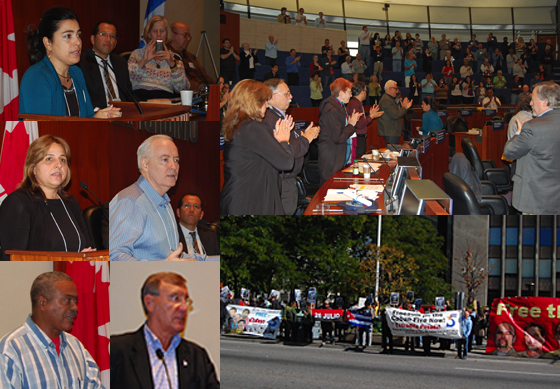
After several months of planning by a coalition of Cuba and other progressive solidarity activists of the Toronto area, 250 people attended a People's Tribunal about the Cuban Five, in the City Hall Chambers of this northeastern Canadian city. There they heard an impressive array of witnesses give testimony to a panel of Magistrates of Conscience on the unjust and illegal political prosecution carried out by the U.S. government against Gerardo Hernández, Ramón Labañino, Antonio Guerrero, Fernando González, and René González. 

 Toronto Composite

After a solidarity evening forum on Friday, Sept. 21, the Tribunal commenced on Saturday, and the ruling was announced by Tribunal Principal Magistrate Juan Carranza. On Sunday, the attendees shared reports on ongoing solidarity work for the Cuban Five's freedom. Sunday at 1:00 pm, a spirited protest was held across from the U.S. Consulate near City Hall.
 
Read the list of witnesses and magistrates below, after the ruling.
 
The following is the ruling from the Peoples' Tribunal and Assembly:
 
This People's Tribunal was convened in Toronto fourteen years after the arrest and detention of Gerardo Hernández, Ramón Labañino, Antonio Guerrero, Fernando González Llort and René González in the United States.
 
After considering all the evidence before this Peoples' Tribunal, we find:
  1. There is overwhelming and compelling evidence as to the activity of terrorist groups in Southern Florida, groups which have planned and executed terrorist actions against the people of Cuba for decades in contravention of U. S. and international law.
  2. Every country has the right to defend itself and in that context, the Cuban Five acted in the least adversarial and nonviolent manner to prevent acts of terrorism without engaging in actions against the national security of the United States.
  3. The U.S. failed to take any action to prosecute the actual terrorists in Southern Florida.
  4. We find that men that are peacefully trying to prevent terrorism should not be in prison.
  5. This Peoples' Tribunal condemns the cruel and unwarranted treatment of the Cuban Five during their incarceration.
  6. We find the Trial was a political trial against the Five.
  7. We find there was no credible evidence to support a conviction of conspiracy to commit espionage against the Five.
  8. We find there was no credible evidence to support a conviction of conspiracy to commit murder against Gerardo Hernandez.
  9. We find the U. S. Government interfered in the trial by spending considerable sums of money to pay reporters to write over one thousand printed articles and other television and radio coverage amounting to propaganda which had the unequivocal effect of influencing the outcome of the trial.
  10. We find the court's decision to deny the motion for change of venue was patently unreasonable in light of jury intimidation and a pervasive environment of hostility against the Five.
  11. Therefore this Peoples' Tribunal concludes that the Cuban Five were unjustly detained, unjustly prosecuted, and unjustly sentenced, all contrary to international and U.S. domestic law including the U.S. Constitution. This Peoples' Tribunal proposes the convictions be quashed, and that Gerardo Hernández, Ramón Labañino, Antonio Guerrero, Fernando González Llort and René González be set free immediately, without any restrictions on their liberty.
  12. In the alternative, and in the interest of justice and healing, this Peoples' Tribunal proposes that the President of the United States should exercise his prerogative of a Presidential Clemency and allow the Five to return home.
Toronto Organizers
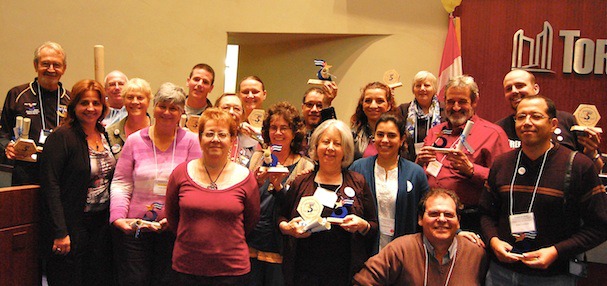
The organizers of the Tribunal, with Elizabeth Palmeiro and Adriana Pérez
 
Tribunal Proceedings
 
Opening Ceremony by Dakota Elliott
Reading of Case Summary by nchamah miller
 
Magistrates of Conscience
Juan Carranza, Lead Magistrate of Conscience
Cindy Sheehan
Chris Levan
Denis Lemelin
Juan Carranza, Lead Magistrate
Julian Rivas
Ken Neumann
Lee Maracle
Marie Clarke Walker
Miguel Barnet
Naveen Mehta
Saul Landau
Tony Woodley
Wes Elliott
William Sloan
 
First Session - Historical and Political Context
Summation of Session
- by Isaac Saney
Tribunal Calls Legal Counsel and Expert Witnesses
Keith Bolender
Raymundo Navarro
Abelardo Paison Reyes
Livio Di Celmo
Arnold August
 
Second Session - Arrests, Trial & Convictions of The Cuban Five
Summation of Session - by Zilpha Ellis
Tribunal Calls Legal Counsel and Expert Witnesses
Richard Klugh
Stephen Kimber
Gloria La Riva
 
Third Session - What has happened since the trial in Florida?
Summation of Session -
by Julio Fonseca
Tribunal Calls Impact Testimony Witnesses
Elizabeth Palmeiro
Adriana Pérez
José Pertierra
Alicia Jrapko
 
Tribunal Calls Legal Counsel for Summation of the Defence
Richard Klugh
Tribunal Calls Magistrates of Conscience to Render the Decisions of the Tribunal
 
Tribunal Calls Lead Magistrate of Conscience for Reading of the Final Overall Proclamation
Juan Carranza 

People's Tribunal in Toronto draws 250 participants
Labor, Law and Community Activists issue
declaration for 
the Cuban Five's freedom
After several months of planning by a coalition of Cuba and other progressive solidarity activists of the Toronto area, 250 people attended a People's Tribunal about the Cuban Five, in the City Hall Chambers of this northeastern Canadian city. There they heard an impressive array of witnesses give testimony to a panel of Magistrates of Conscience on the unjust and illegal political prosecution carried out by the U.S. government against Gerardo Hernández, Ramón Labañino, Antonio Guerrero, Fernando González, and René González. 

 Toronto Composite

After a solidarity evening forum on Friday, Sept. 21, the Tribunal commenced on Saturday, and the ruling was announced by Tribunal Principal Magistrate Juan Carranza. On Sunday, the attendees shared reports on ongoing solidarity work for the Cuban Five's freedom. Sunday at 1:00 pm, a spirited protest was held across from the U.S. Consulate near City Hall.
 
Read the list of witnesses and magistrates below, after the ruling.
 
The following is the ruling from the Peoples' Tribunal and Assembly:
 
This People's Tribunal was convened in Toronto fourteen years after the arrest and detention of Gerardo Hernández, Ramón Labañino, Antonio Guerrero, Fernando González Llort and René González in the United States.
 
After considering all the evidence before this Peoples' Tribunal, we find:
  1. There is overwhelming and compelling evidence as to the activity of terrorist groups in Southern Florida, groups which have planned and executed terrorist actions against the people of Cuba for decades in contravention of U. S. and international law.
  2. Every country has the right to defend itself and in that context, the Cuban Five acted in the least adversarial and nonviolent manner to prevent acts of terrorism without engaging in actions against the national security of the United States.
  3. The U.S. failed to take any action to prosecute the actual terrorists in Southern Florida.
  4. We find that men that are peacefully trying to prevent terrorism should not be in prison.
  5. This Peoples' Tribunal condemns the cruel and unwarranted treatment of the Cuban Five during their incarceration.
  6. We find the Trial was a political trial against the Five.
  7. We find there was no credible evidence to support a conviction of conspiracy to commit espionage against the Five.
  8. We find there was no credible evidence to support a conviction of conspiracy to commit murder against Gerardo Hernandez.
  9. We find the U. S. Government interfered in the trial by spending considerable sums of money to pay reporters to write over one thousand printed articles and other television and radio coverage amounting to propaganda which had the unequivocal effect of influencing the outcome of the trial.
  10. We find the court's decision to deny the motion for change of venue was patently unreasonable in light of jury intimidation and a pervasive environment of hostility against the Five.
  11. Therefore this Peoples' Tribunal concludes that the Cuban Five were unjustly detained, unjustly prosecuted, and unjustly sentenced, all contrary to international and U.S. domestic law including the U.S. Constitution. This Peoples' Tribunal proposes the convictions be quashed, and that Gerardo Hernández, Ramón Labañino, Antonio Guerrero, Fernando González Llort and René González be set free immediately, without any restrictions on their liberty.
  12. In the alternative, and in the interest of justice and healing, this Peoples' Tribunal proposes that the President of the United States should exercise his prerogative of a Presidential Clemency and allow the Five to return home.
Toronto Organizers
The organizers of the Tribunal, with Elizabeth Palmeiro and Adriana Pérez
 
Tribunal Proceedings
 
Opening Ceremony by Dakota Elliott
Reading of Case Summary by nchamah miller
 
Magistrates of Conscience
Juan Carranza, Lead Magistrate of Conscience
Cindy Sheehan
Chris Levan
Denis Lemelin
Juan Carranza, Lead Magistrate
Julian Rivas
Ken Neumann
Lee Maracle
Marie Clarke Walker
Miguel Barnet
Naveen Mehta
Saul Landau
Tony Woodley
Wes Elliott
William Sloan
 
First Session - Historical and Political Context
Summation of Session
- by Isaac Saney
Tribunal Calls Legal Counsel and Expert Witnesses
Keith Bolender
Raymundo Navarro
Abelardo Paison Reyes
Livio Di Celmo
Arnold August
 
Second Session - Arrests, Trial & Convictions of The Cuban Five
Summation of Session - by Zilpha Ellis
Tribunal Calls Legal Counsel and Expert Witnesses
Richard Klugh
Stephen Kimber
Gloria La Riva
 
Third Session - What has happened since the trial in Florida?
Summation of Session -
by Julio Fonseca
Tribunal Calls Impact Testimony Witnesses
Elizabeth Palmeiro
Adriana Pérez
José Pertierra
Alicia Jrapko
 
Tribunal Calls Legal Counsel for Summation of the Defence
Richard Klugh
Tribunal Calls Magistrates of Conscience to Render the Decisions of the Tribunal
 
Tribunal Calls Lead Magistrate of Conscience for Reading of the Final Overall Proclamation
Juan Carranza 

September 25, 2012

Wave of high school protest sweeps Ontario in support of teachers


PV Ontario Bureau 

Ontario high school students are answering the passing of the McGuinty Liberal’s “Put Student’s First Act” or Bill 115 with a wave of walk-outs and protests across the province.

Students in multiple high schools have walked out in large and small communities. New reports have been filed from Toronto, Richmond Hill, Mississauga, Brampton, Bluewater, Georgian Bay, Owen Sound, Goderich, Wingham, Flesherton, Clarington, Kingston, the Kwartha Lakes, the Quinte region, and Ottawa – easily totaling over ten thousand students.

The actions overwhelmingly appear to have been in support of the teachers with students waving signs like “Your child’s future was the first to go with budget cuts,” “Putting students first means putting teachers first,” and “Democracy Last Act, Bill 115.” In some cases the students headed down to the local office of their Member of Provincial Parliament and staged rallies.

Many of the actions have been organized by social media. “The students are walking in support of teachers who are upset about their right to bargain and the withdrawal of extracurricular activities. The support and effort teachers give to students through education and especially their dedication to extracurriculars is beyond that call of duty, and that’s why students are walking out in support of teachers,” one pro-walkout Facebook group description said.

Speaking at a meeting of the Toronto Young Communist League, Ontario YCL organizer Drew Garvie held up an article from a newspaper report on the student protests and pointed out that the photo – which showed Stop Bill 115 signs – was the opposite from the anti-teacher message of the accompanying article.

High school students are already getting in touch with student unions and other progressive organizations including the YCL, he said.  “This is an attack on the entire education system and it is important for college and university students, and young workers in general, to be in support of these actions,” Garvie said.

The Ontario YCL is issuing a statement, which will be available on the YCL’s website and Rebel Youth blog, calling for “high school and elementary students to rise up in support of our teachers” and force the repeal of Bill 115. “Teachers working conditions are students learning conditions,” the statement says.

“Education is not a business opportunity to make profit, it is the right of the youth, and a keystone in securing our future.  Another vital necessity for quality education is the right of teachers to form, participate, and be represented by their labour unions,” the statement says.

“The government is telling everyone a Big Lie. They say there is no money, and no alternative to Bill 115’s anti-union measures. But Ontario is a province with tremendous natural wealth, a surplus of the super-rich, and many giant corporations and banks -- controlling all of the wealth.  In their shadow stand our hospitals, transit system, and schools that remain underfunded and neglected by the government. Who made the crisis in education? It wasn’t the teachers or the students – it was government policies which pay no serious regard to people’s needs, only corporate greed,” the statement says.

The YCL is fully supporting the student walk-outs and calling for them to spread. “When injustice becomes the law, resistance becomes a duty [...] Organizing a walk out can be done quickly and successfully using social media, word of mouth, defiance, courage and unity. Convince your friends. Convince your class. March through the halls and hit the streets!  You can suspend one student, but you cannot suspend hundreds.”

So far there have been no reports of students being disciplined because they participated in protests.

Victories in Quebec, but struggle must continue warn social movements

J. Boyden

In one day, the newly elected Parti Québécois (PQ) minority government led by Pauline Marois swept away most of the keystone austerity policies of the previous Charest Liberals. The new Quebec government, brought to power on winds of change generated by historic mass mobilizations, also realized victories for the environmental movement.

The PQ government cancelled the proposed massive tuition fee hikes; repealed the repressive Bill 78 drafted against the student protests which put severe restriction on civil, labour democratic rights; and announced the cancellation and reimbursement of the new $200 health tax. The action satisfied three out of four of the main demands of the student-labour "Red Hand" Coalition that was at the core of the extended student strike mobilizations last spring. "The abandonment of these measures, criticized by large sections of society, demonstrates that popular mobilization bears fruit," said social housing activist Véronique Laflamme who is also a spokesperson for the Coalition.

An announcement by the PQ on the Coalitions fourth major demand, stopping the increase in Hydro fees, is expected soon. However, as a statement by the Coalition said, "in the context of a minority government, the fate of some [PQ] measures depend on the support received by the Liberal Party or the [ultra-right] Coalition Avenir  Québec (CAQ), two parties that openly advocate user-fees and the privatization of public services, and austerity measures [...] the business community and think tanks use the right-wing media platforms they have to decry tax measures that require greater contributions from big business and the wealthy."

"Mobilization remains necessary now, not only to avoid setbacks but to go further in the implementation of a better redistribution of wealth in order to address growing social inequalities," said Régine Laurent, President of the FIQ Nurses Union and a spokesperson for the Red Hand Coalition.  The PQ is proposing the idea of retro-active taxation on high-income earners, making more than $130,000 and more than $250,000. The tax readjustment will also apply to businesses, and has engendered opposition from pro-corporate forces.

Student organizations have cheered the announcements, while noting that the PQ is planning a mass-consultation with the people of Quebec in the coming months, and that it will likely advocate for a tuition increase at a slower rate. The ASSÉ and its broader CLASSE alliance are heading to convention to determine strategy and if the CLASSE formation should continue. One proposal is to embark on a cross-Canada campaign against the Harper Conservative policy on education and youth issues.

Marois' new cabinet members also made announcements realizing victories for the environmental movement, stating that they will scrap a loan to revive Quebec's last asbestos mine, raise royalties on mining, re-draw the Plan Nord, close the widely criticized Gentilly-2 nuclear power station, and continue the moratorium on shale gas and the procedure of Hydraulic fracturing, widely condemned by scientists and greens alike.

"I don't foresee a day when there will be technology that will allow safe exploitation [of shale gas]," Natural Resources Minister Martine Ouellet told CTV news before her first cabinet meeting, adding: "Our position is very clear: we want a complete moratorium, not only on exploitation but also on exploration of shale gas." Although public outcry and widespread mobilizations forced the former Liberal government to halt shale-gas exploration last year (to conduct more studies on the ecological risks) the PQ leader distanced herself from Ouellet's remarks but said she would close down the Gentilly-2 nuclear plant.

In the 1960s the Gentilly stations, located in Becancour close to Trois-Rivières, were to be the flagship of over thirty nuclear plants in  Québec. Public pressure helped block those plans and today Gentilly-2 is the only nuclear power station in  Québec and generates less than 4% of provincial electric power.

Environmentalist point to studies showing higher rates of cancer, not just five kilometers from the center, but up to 70 km away. While a potential shut-down will be very costly and will be strongly opposed by the Liberal and CAQ parties, it is made much easier by the fact the power station remains under the control of the public corporation Hydro-Québec.

"We support this closure fully but the people can not again fall into the trap of healthy environment or jobs," said Marianne Breton Fontaine, leader of the Young Communist League of  Québec. "Labour, environmentalists and youth must stand together and demand the workers at Gentilly-2 maintain their jobs at Hydro-Québec with no loss in pay or benefits, through Green Jobs that preferably allow them to remain in their current community. Hydro-Québec is hardly in a financial crisis and Québec in general needs to pursue new, environmentally sustainable power sources like wind energy," she said.

Popular stories