February 14, 2013

On Valentines - solidarity with missing and murdered Aboriginal women


Rebel Youth has received this commentary about the crisis of missing and murdered Aboriginal women in Canada. We are reprinting it also in the context of the build-up to International Women's Day 2013.

By Darrel Rankin, CPC Manitoba

On this day of action for murdered and missing Aboriginal women in Canada, we are circulating yesterday's report from Human Rights Watch on the issue (read the report summary here).

It focuses on B.C., but the brutal racist and sexist realities are no different in this part of Canada, reported and unreported. (For example, see this "Letter from a Grandmother" we ran in the past - RY eds.)

This is a systemic problem, connected to the oppression of both women and Aboriginal nations in Canada by the dominant, English-speaking nation and Quebec, a nation which itself is in an unequal union with the non-Aboriginal "rest of Canada." Like war, the inequality of nations is an inherent part of capitalism in its late stage of development.

Solving the problem will require fundamental social change, curbing and ultimately ending the immense power of the corporate elite who benefit from all forms of discrimination and inequality, dividing working people and creating pools of super-exploited labour that drag all wages down.

(Extra: Read the YCL solidarity statement on the Sisters in Spirt campaign from 2011)

In serious denial, the largest oppressor nation (or its political, corporate class) doesn't have a name for itself, because it refuses to recognize the genocidal crimes it continues to commit. It calls itself "Canada," claiming we have a "multi-cultural" society with no other real nations, except Quebec which Harper recognized because it is an equal opportunity oppressor of Aboriginal nations. Je me souviens Oka.

Human Rights Watch is playing a useful role by helping expose the crude police state Aboriginal peoples are resisting in Canada, although I disagree with the role it has played in other parts of the world. (About HRW's role elsewhere, see for example here or here.)

The Aboriginal rights struggle requires the full solidarity of Labour and other popular movements. May Aboriginal nations win full rights and equality, and soon.


Links and related reports (with thanks to Eagle Watch):


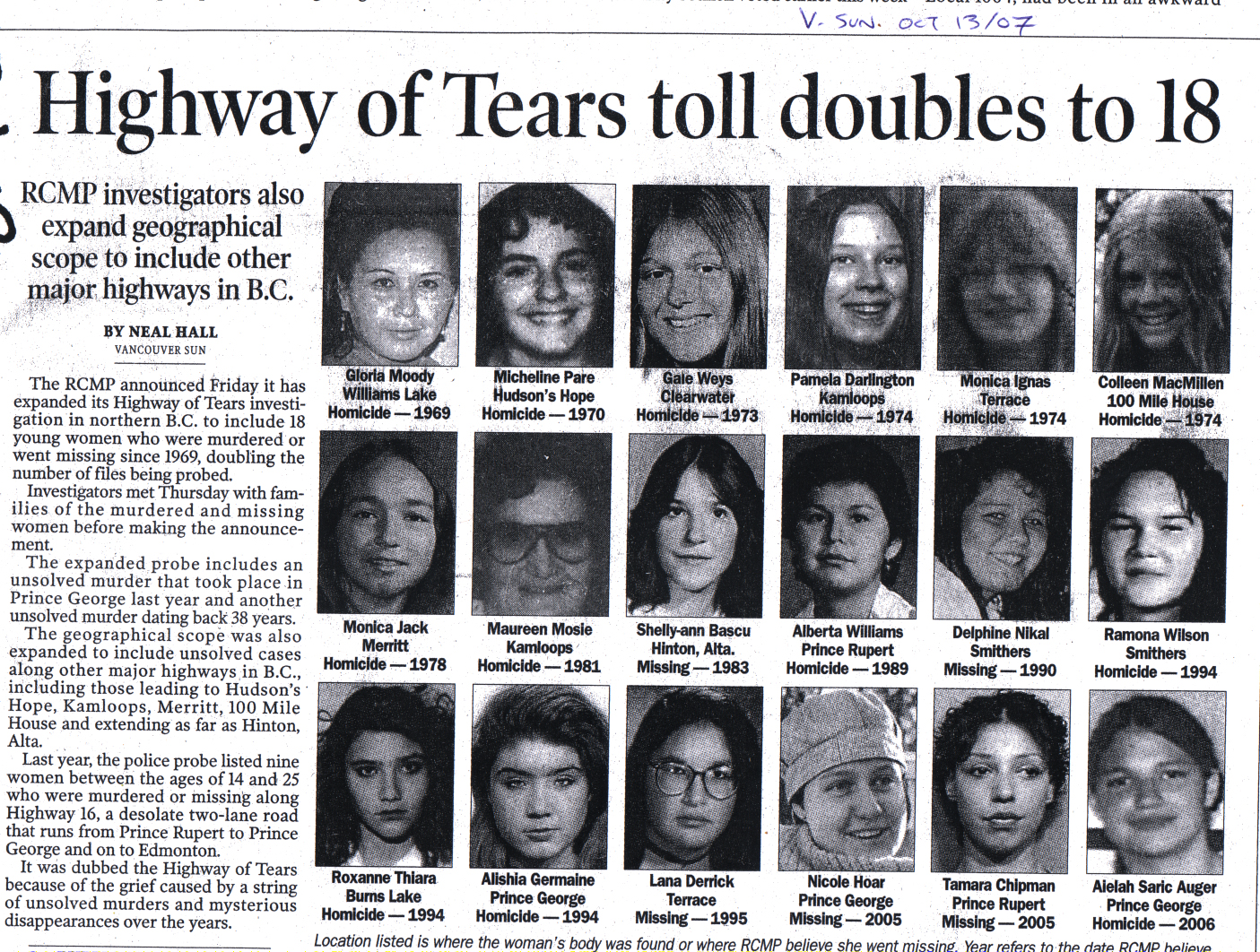
Canada: Abusive Policing, Neglect Along "Highway of Tears"

Media report on the Highway of Tears

Human Rights Watch yesterday joined calls for the establishment of a Cross-Canada inquiry into the murders and disappearances of Indigenous women and girls. Their full release is below. Rebel Youth reprints this also as part of a series of articles we are running in the lead-up to International Women's Day.

The Royal Canadian Mounted Police in northern British Columbia has failed to protect indigenous women and girls from violence, Human Rights Watch said in a report released today. Women and girls Human Rights Watch interviewed also described abusive treatment by police officers, including excessive use of force, and physical and sexual assault.

Who are the richest 1%?

Rebel Youth

In our last print issue we published a special discussion about the strategy and tactics of youth and student struggle and the Occupy movement by Drew Garvie.

Since that time the Occupy movement has not gone away but its biggest impact remains its slogans of solidarity and class struggle, about the 1% and the 99%. Some of our readers asked for more information about who, exactly, are we talking about when we speak of the 1%?

Helpfully, the labour publication BC Federationist put out a quick summary of a new study from a group of University of British Columbia economics professors.

What the report doesn't conclude is, of course, key in our analysis here at Rebel Youth: that the real 1% are a class because of their relationship to economy or (more precisely, the mode of production) not percentages of income.

As the saying goes -- their are those who work, and those who work them.  As such the power and influence isn’t just from having loads of money (which can also be obscured from census collectors and the tax man) but as a class. Moreover, monopoly capitalists don't make a wage. Instead, they make profits which come from  -- like vampires sucking on workers wages.

Still, the information is useful and striking.

According to the BC Federationist the UBC researchers found, broadly speaking, that income distribution has not been this uneven in Canada since “the dark days of the Great Depression.” “The ratcheting-up of inequality in Canada is real,” the 43-page paper says.

In Canada, about 8 per cent of the country’s total income was concentrated in the hands of 1 per cent of the population back in the late 1970s. In recent years, that almost doubled to 14 per cent, the UBC paper said, which is based in part on details from the 2006 long-form census.  Reasons for the growing chasm vary.

The wage gap between those with a university degree and those with just high school is widening. Younger workers are facing worse earnings prospects than a generation ago. Outsourcing, declining unionization rates and technological change may also be playing a role.

Here are some more of the findings from the study, entitled “Canadian Inequality: Recent Development and Policy Options”:

  • The top 1 per cent of earners amount to 275,000 individuals.
  • You need an annual income of at least $230,000 to be part of the top 1 per cent; the average income in this group is $450,000, compared to only $36,000 for the whole Canadian population.  
  • One could safely call this a brotherhood — 83 per cent of those in the top 1 per cent are men.   
  • Just 10 per cent of people in the top 1 per cent work in the finance and insurance industry (despite garnering most of the public’s wrath). Senior managers and CEOs are over-represented in the top group, but still only account for 14 per cent of top earners. The only other large group of top income earners? Physicians, dentists and veterinarians who comprise almost 10 per cent of top earners, despite representing less than 1 per cent of the workforce.

The paper was jointly written by UBC’s Nicole Fortin, David Green, Thomas Lemieux, Kevin Milligan and Craig Riddell for the Canadian Labour Market and Skills Researcher Network.

February 13, 2013

Fire Kevin O'Leary campaign hits News Talk 1010


Click above for a video of Rebel Youth spokesperson Drew Garvie calling out Kevin O'Leary and his agenda of 'Greed is good' from the CBC.

Popular stories